
FAQ
RFRN: Mission Statement
The purpose of VFF’s Rebuild Free Radio Network (RFRN) is to leverage low cost, low barrier methods so that New Zealanders can communicate in a regular, effective, and streamlined way across the country using radio.
The ultimate goal of RFRN is to create a communications network that is independent, reliable, and robust, which encourages and enables its participants to be resilient and confident in their ability to communicate via radio in situations such as a power outage.
By combining the experience and expertise of our community with publicly available radio frequencies, low-cost equipment, and the existing power of our far-reaching network, RFRN connects people from the grassroots level within close proximity neighbourhoods, working towards connecting wider areas such as towns, cities, and regions, and ultimately to the furthest inter-island reaches possible.
RFRN: Open to All
The Rebuild Free Radio Network (RFRN) is an initiative from Voices for Freedom.
It is open to all interested, like-minded people who wish to explore and cultivate alternative communication options to stay connected with others throughout the country.
Primarily focused on handheld PRS radio which is readily available and usable by anyone without fees or licenses, RFRN is also supported by communications specialists and licensed ham radio operators who can enhance the network via more expert methods.
The VFF Code of Conduct underpins all conduct and behaviour within the RFRN community, and we encourage all involved to familiarise themselves with these important guidelines.
VIEW THE VFF CODE OF CONDUCT: https://www.voicesforfreedom.co.nz/code-of-conduct/
Our Rebuild Free Radio Network (RFRN) is headed by Linc, our RFRN National Coordinator. A recently retired industrial electrician, Linc specialised in automation and control of large, fully automatic, multi pump irrigation systems as well as council pump stations. This includes town water supplies and sewerage stations, often remote monitored and remote controlled, using telemetry (radio signals) and sometimes powered by off grid supplies due to the remote locations.
As a daily part of the job throughout his career Linc has regularly used RT (Radio Telephone) communications, which often reach beyond the scope of cellphone coverage, as well as PRS handheld radios.
Additionally, Linc has extensive experience in the audio industry, giving him a unique understanding of waveforms and their behaviour in both the audio and radio spectrums.
Linc is a recently licensed amateur radio operator (“HAM radio”) and is coordinating the connection of radio groups throughout NZ, both locally and nationally.
Most areas are using 80 channel UHF PRS (“cb”) radios for their local networks and only using “ham” radio links for specific difficult links. This choice is the consensus of the vast majority of the radio hams and leaders we have spoken to, as the PRS radios are cheap and readily available to anyone without a license. (Ham radio needs a license to operate and is a whole different ball game as far as the average person is concerned. We can’t expect many people to get ham radio licensed and if too many did it might raise questions about what we are doing)
PRS radios can have vast range if set up with remote aerial(s) on the car/house roof(s). Also, there are a number of publicly available repeaters around the country that extend the range even further, often hundreds of km. These are often solar/battery powered due to their remote locations on top of hills, so will often keep working if the power grid goes down, but there are problems with these going down in disasters, either from damage by weather/fire, or the batteries going flat from excessive use and insufficient sun to recharge the batteries.
As such, we recommend using simplex channels (radio to radio using a single channel) wherever possible and not relying on a third party device like a repeater.
We have worked with Techoman to create a standardized package for our members to purchase, either individually or in bulk. This sets up the vast majority of our members with everything they need in a simple to use but cost effective package. It also removes any confusion on what to buy and standardises our groups so we can all help each other use them.
If you are a VFF member and would like the region specific discount code, please sign up to our database and we’ll send it to you.
https://techoman.co.nz/products/baofeng-uv-81c-uhf-prs-radio-for-mobile-and-home-package
Roof mount aerials are a huge advantage. Everyone should invest in decent high gain Aerials for their car and house roofs. They can plug in to your handheld if it has a removable aerial, so you wouldn’t need any other radio units. These aerials can more than quadruple your range, so well worth the investment.
Great in crowds but relies on users being in close proximity to each other. Bluetooth only works out to 100m absolute max, usually more like 10m. For example Bridgefy uses all users as a bridge to all other users, as the name suggests. If you have a gap in the user network of say 100m, it will break the network chain.
This is why we are building the Rebuild Free Radio Network, and over time it will cover the whole country, from Cape Reinga to Bluff.
This will require a person in each PRS group to have a long range CB Radio. One option is that these radios be group funded in each area, to share the cost of the unit (estimate $900 – $1,000) among the members and make it available to the most appropriate member, who ideally should be in a fairly central location within their group so that all their group can get hold of them, as well as on a high point or hill, if possible, or an open flat area not surrounded by hills or big trees.
Group funding the long range radio removes the politics and the obligation to be the long range radio person long term; if they get sick of the responsibility or circumstances change, the radio can be shifted to another member’s location.
The long range 27mhz SSB CB radio kit is now available from Techoman, search for:
TM9100/10M
This is the radio, plug in power supply, 6metre tall antenna and 10m of antenna cable, all for $775.80, less your VFF discount (use your regional code) but you will also need a 7ah (or greater) 12 volt backup battery, a 150watt “12 volt” solar panel and a basic charge controller, which must be sourced elsewhere, such as trademe, solar suppliers, or Jaycar.
Total cost is estimated between $900 and $1000 EXCLUDING installation, which is not “plug and play”, it is substantial and requires a tradesman such as an electrician, or a capable handyman/radio ham.
Linc installed a long range radio in Nelson. This radio was group funded by the Nelson radio group members (VFF members) so is a VFF community owned radio for the Nelson region. This is how we want to fund all the long range radios nationwide, as it future proofs the inter regional connection for the group:
The group radio is to be placed with the most appropriate radio group member, in this case, it is currently one who lives on a hill in a central location. With a very effective 10.5dbi fibreglass dipole antenna on their PRS radio, they can talk to most of their radio group members directly on their PRS radio (indirectly to outlying members) as well as to other regions on the SSB CB radio.
Thank you to Smurf in Rangitikei for these guidelines:
- Listen to Linc’s talk. https://rumble.com/v3n3sm3-cb-radio-seminar-vff-nz.html
- Talk slowly, introduce yourself 3 times.
“Good evening. This is Smurf calling Smokey, Smurf calling Smokey, is Smokey listening, Smurf calling Smokey. You got your ears on, Smokey?”
Should take enough time so as the intended recipient PRS on seek mode will scroll around and pick up the call. - After Smokey gets back, use “over” when finished talking. Don’t leave big gaps in speech with mic on.
If thinking, call “over” and write it down. - Use “over and out” to finish. Once “out” don’t come back in until everyone else has finished. Then call again.
- To talk “private”, as much as open airway is private, choose a different channel after contacting.
“Smokey. Can we move to channel 35? Over.” - Ensure you choose a channel you’ve checked for a while that is not well used by others…
E.g. I’ve ticked off all channels where I’ve heard people talking over a week of PRS on seek.
Skip only works on the HF (High Frequency) range, which is what the long range SSB CB radio uses. Skip will not work on the PRS radios (these are for your local area connections only.)
Skip comes and goes. One day, we might reach Australia, another day we won’t get more than the neighbouring region. If skip is good, 500km is easy, even 5000km is possible. If skip is bad, you might be down to 50km.
The 26/27mhz CB band will get best skip during the daytime, as it sits at about 11metres wavelength. The 40m and 80m bands work better at night.
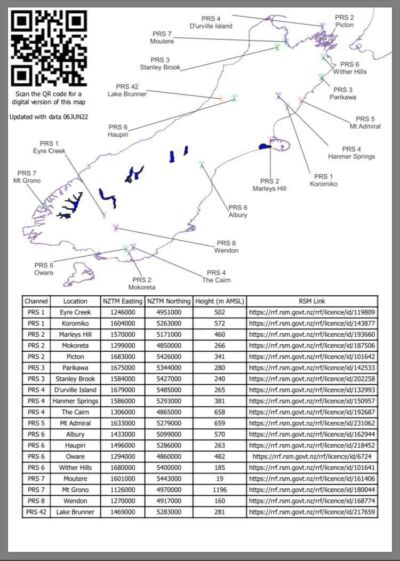
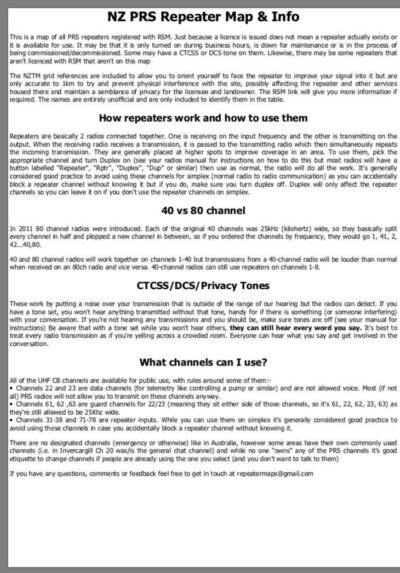
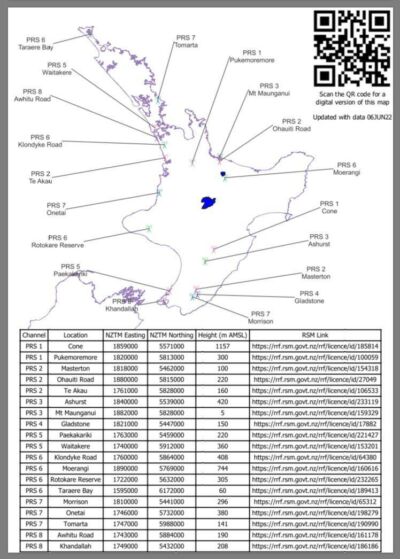
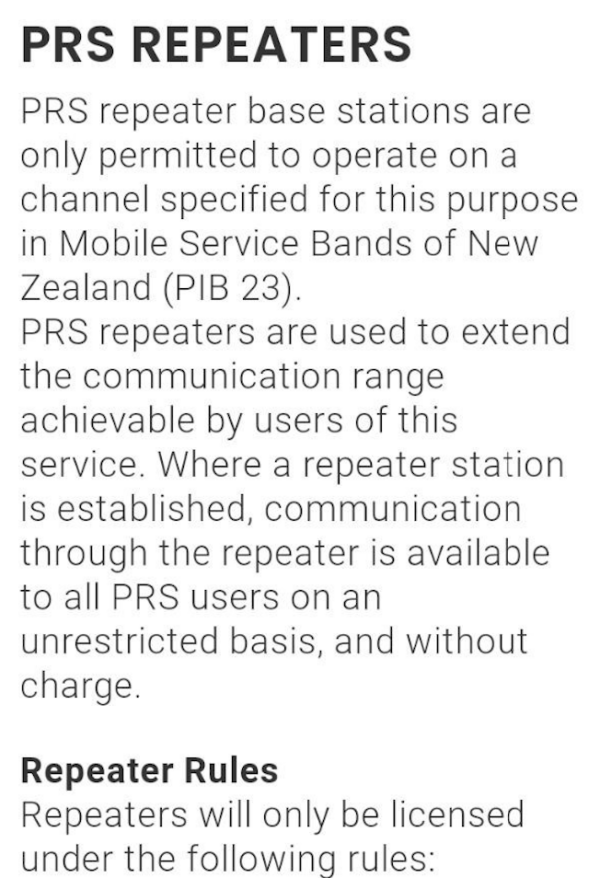
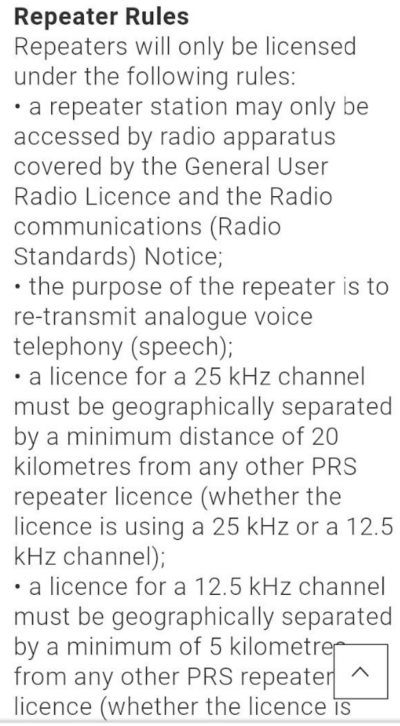
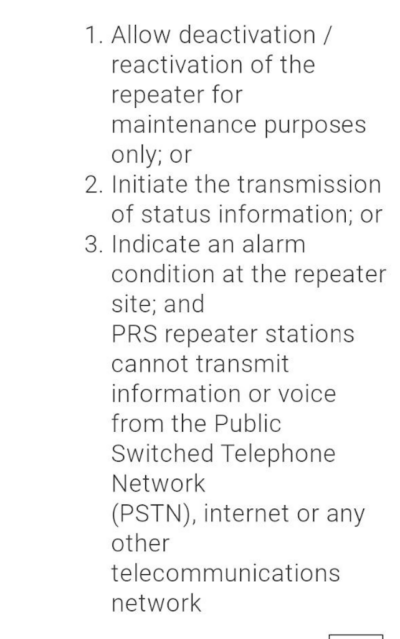
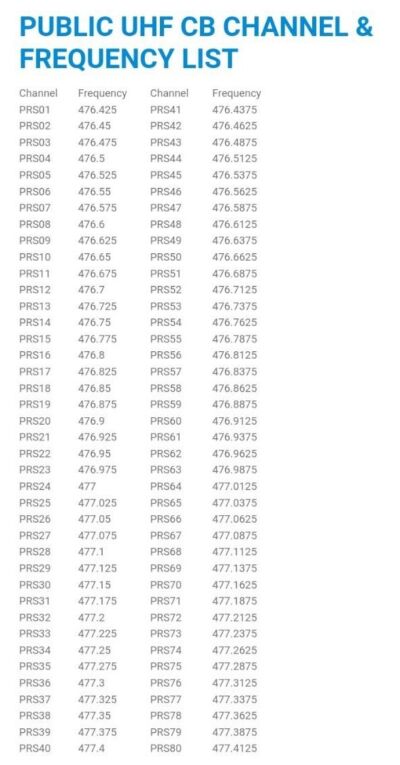
There are several places you can find repeater locations throughout NZ; we have listed a few of them below.
While there is no guarantee that any list will be complete, accurate, or that the repeaters listed are still functional, together the following links and information should give you a fairly complete picture.
You can test whether a repeater is operational by trying to use it.
https://blowonthepie.co.nz/prs-uhf-repeaters-nz/
We are not recommending people buy marine radios for a number of reasons, but if you already have one, this info may be useful.
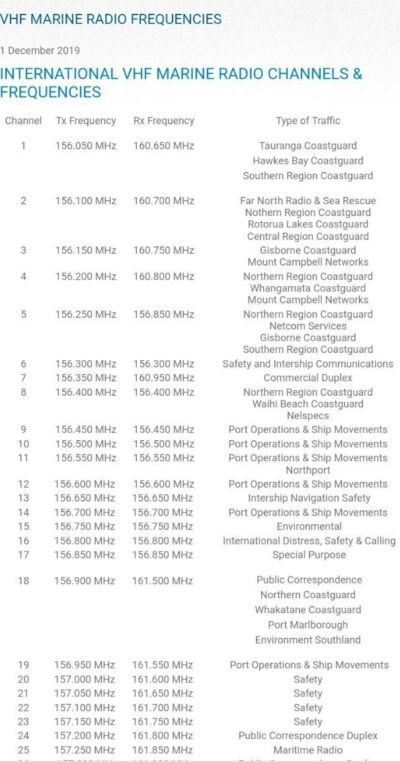
Assuming no significant obstacles in the way of your transmission:
– With standard handheld: 5-10km
– With high gain whip antenna: 10-15km
– With car roof antenna: 15-20km
– With roof antenna: 20-50km
These are a rough guide and these distances have sometimes been exceeded significantly, and other times are not achieved for a variety of reasons.
Techoman has some range estimations on his site. The communications range (distance) listed on this web page is significantly less than has been achieved personally, which Linc talks about in his presentation. This is because many of the general public could buy these radios and expect them to work long range in “the concrete jungle” (or an actual jungle) and be disappointed, so the range listed is “ass covering” to allow for these significant obstacles.
This page is intentionally NOT called “Personal Emergency Communications” as some may read this as the UHF PRS Radios having the ability to call
emergency services direct or that it could be a replacement for a phone capable of dialing 111
Have a look, there is some useful info and a link to the radio kit.
These video guides will get you started with the assembly and basic use of the portable PRS radio.
This little video guide will get you started with assembling and using your antennas that come with the kit. These antennas are the key to getting significant distance with your communications.
Who has heard of the Doppler effect?
The same principle applies to radio waves converging on a single point. They can add in one place to make a strong signal, while in another spot just next to it, they can be cancelling to give no signal.
If you are not getting the results you think you should, it may be as simple as shifting your house antenna slightly. The wavelength of 477mhz PRS is about 0.62 of a metre, so shifting the antenna slightly, even as little as 0.3m, about the length of a ruler, might be all that is needed.
More on the pole for the house roof antenna:
Buy a length of “3/4 inch” galvanized steel water pipe. This will be 6 metres long and approximately 1 inch outside diameter and the antenna will attach to one end. Tape the cable to the pole and stand it up, attach to side of house/fence/etc with STURDY fixings, like saddles (using screws), and run cable in window.
If you have trouble transporting a length of pipe (6metres long) then get it threaded at the ends, if it’s not already, buy a socket joiner, and get it cut in half. You can transport it as a 3m length and join the two threaded ends at home with the joiner.
For those installing a “long range radio” (SSB CB) the antenna should be installed like this, with nylon stay lines to stop damage in high winds. (see images)
Q: How long is that element, and can you describe the ground plane too? Also, is there a minimum height (measured in wavelength I guess) above obstacles like a house?
A: It’s almost 6 metres long, has 3 ground radials at the base, almost a metre long each and minimum height is “above the roof” and any other metal, or trees too, ideally.
The higher the better for this antenna, and preferably your location would be on a hill.
The signal loss over the cable at 27mhz is less than that of PRS at 477mhz, so you can run a longer cable with minimal impact. 10m is standard, but you could go to 20m or even 30m but at that point I’d be considering low loss cable.
Q: Ok. That’s good to know about cable losses. Have you got the ground plane at the bottom of the element right – not the bottom of the mast?
A: Yes, bottom of the element. It’s a kitset 27mhz antenna from Techoman, made in NZ especially for Techoman.
Stay wires should not be necessary on the PRS antenna pole.
It would certainly be good to earth it, but not necessarily a requirement when running a ground plane radial.
Earthing it will make sure that any radio frequency signals that are picked up by the pole are not going to affect the antenna by modulating the ground plane. It will also attract lightning in a thunder storm as it will provide a good path to the earth for it. As such, do not connect the pole to your house earth wiring, which could also induce radio frequency interference in some circumstances.
Drive a separate, dedicated earth stake (warratah would do, but a proper electrical earth stake is better), connected to the pole with a thick earth wire, 6mm2 would do (same size as the wire to your house earth stake).
We tested the UHF PRS radios with an EMF specialist and can say with confidence that these radios do not emit any detectable levels of EMF when you are listening, only when you transmit (talk to someone else on it). The levels emitted during transmission are 2 to 3 points above the recommended safe levels for close proximity CONTINUOUS exposure, so on an intermittent basis, which is how these are used, it is not a significant concern. The frequency is also a lot lower than that of cell phones and much lower than that of 5g cell phones, so that is a plus too. The antenna accessories that come with the kit are another layer of protection, with the car and house antennas giving you a substantial isolation from the radiated signal while transmitting, making them safe for any length of time transmitting.
To change channel quickly on the UV81C, hold the down arrow key until it beeps, continuing to hold for 2 seconds after the beep will change down approx 20 channels, 3 sec after beep = 30 channels etc, It loops from ch1 back to ch80 counting down at 10 channels per second until you release the down arrow key.
If you are looking to purchase a radio, please follow these direct links to Techoman (our preferred supplier) for the current recommended radio: the TM905PRO.
🎙Radio equipment: Techoman links to the TM905PRO:
🔗 TM9006 Home/Mobile Kits: https://techoman.co.nz/search?q=tm9006
🔗 TM1663 Extra Handset https://techoman.co.nz/search? q=tm1663 (as the kit only comes with one radio, you may like to add an extra handset)
🔗 TM0506 Extended Range Whip Antenna: You may wish to add this for the extra handset if you purchase one: https://techoman.co.nz/products/techoman-na-771-tuned-477mhz-uhf-prs-antenna-black-sma-f-flexi-antenna
🔗 All Equipment: https://techoman.co.nz
🛠 Note: RFRN has no affiliate arrangement with Techoman, who we recommend as a trusted supplier for reliable products and service.
Extras:
- TM0353 – Magnetic Mount Antenna for car roof
- TM0363 – Rainproof Speaker Microphone
- TM0506 Extended range antenna (whip) with SMA female to suit the standard TM905PRO radios
- TM0459 Extended range antenna (whip) with SMA male plug to suit some GME and Uniden radios.
- TM770B-477 Complete base station antenna (house roof)
- TM0007 This is the standard 100cm (1 metre) cable with the SMAFemale and SO239 socket to connect the house roof antenna to the TM905PRO handheld radios.
- TM0523 This is the alternative 100cm (1 metre) adapter cable for houseroof antenna to fit some GME and Uniden radios (SMA-Male)
- TM0168 – Spare 1800mAh Battery
- TM0177 – Spare 3800mAh Battery
Alternate bundles:
- TM9002 – Crystal DB477A UHF PRS Home Base Radio, PSU with Outdoor Antenna Package. (This is a more expensive, fixed base station radio. This is only for those with good finances who want an extra radio always at their house. This is not mobile, so can’t be taken out with you and has no range advantage over the standard package handset. It also has no battery backup, but you can add any 12 volt battery to this to give backup when power is off.)
- TM9003 – Crystal DB477A UHF PRS Mobile Radio with Antenna Package. (This is a more expensive fixed mount radio for permanent install in one vehicle. It has the same transmitter power as the standard package handset, but may have a slight range advantage due to a slightly higher Gain antenna, permanently fixed to your vehicle.)
The better radio with improved filtering and water resistant, is TM820P from Techoman.
GME reverse SMA antennas:
- TM0187 (not the 485mhz option, look for this one): UHF PRS 477MHz Magnetic Mobile Antenna Black 4.5dbi with SMA Male Connector for GME Radios
- TM0507 Extended range antenna (whip) with SMA male plug to suit GME radio
- TM0304 Complete base station antenna (house roof) 4 cable lengths to choose from.
Remember to order the adapter cable (below)
- TM0523 This is the alternative 100cm (1 metre) adapter cable for house roof antenna to fit some GME and Uniden radios (SMA-Male)https://techoman.co.nz
While TM820P PRS radios with better filtering can resolve issues like the case of Hawke’s Bay interference, they do have some disadvantages.
Slightly more expensive, we also found that these radios don’t have a channel scan function, flashlight, or a key lock, and, until recently they don’t charge from USB.
The handset is chargeable from a 12 volt battery if you make up an adapter lead, but other than that, it’s a plug-back only to charge.
With some cunning you can find an off-grid way of charging it from a 12-volt supply but it won’t charge from USB, even by that adapter lead that converts it to 10 volts, because it needs 12 volts to charge it.
So, this presented a bit of a challenge.
But thanks to Techoman, you can now choose a USB-C Battery with the TM820P Radio. (Remember to choose the USB C battery option in the option box with the drop down arrow.)
NB: the TM820P based kitset “Home and Mobile package” (TM9004) automatically has a USB C type battery included.
The USB C type battery will still charge from the TM820P charge cradle with wall plug, included with the radio, but has the option to also charge from a USB lead with C type plug, like most cell phones use.
This lead is not included, but can be purchased separately if you don’t have one. The order code for the lead is TM1229.
Below is a link to all the items that have been added and can now be purchased online using the VFF discount codes:
Despite the few challenges with this alternative radio, with the option of a USB-chargeable battery it can make a viable alternative to the usual handset wherever interference is an issue.
Thank you to Smurf in Rangitikei for these tips:
1. Talk slowly, introduce yourself 3 times.
“Good evening. This is Smurf calling Smokey, Smurf calling Smokey, is Smokey
listening, Smurf calling Smokey. You got your ears on, Smokey?”
Should take enough time so as the intended recipient PRS on seek mode will scroll around and pick up the call.
2. After Smokey gets back, use “over” when finished talking. Don’t leave big gaps in speech with mic on.
If thinking, call “over” and write it down.
3. Use “over and out” to finish. Once “out” don’t come back in until everyone else has finished. Then call again.
4. To talk “private”, as much as open airway is private, choose a different channel after contacting.
“Smokey. Can we move to channel 35? Over”
RFRN Telegram Channel
https://t.me/RebuildFreeRadioNetwork
With notices, updates, how-to info, videos, & more
Join the Rebuild Free Radio Network (RFRN) Database:
Complete the form at https://www.cognitoforms.com/TJB2021LtdVFF/RebuildFreeRadioNetworkDatabase
Linc’s interview with Rodney Hide on Reality Check Radio:
https://realitycheck.radio/replay/linc-preparedness-on-creating-an-independent-cb-radio-network-in-nz/
Techoman packages:
https://techoman.co.nz/products/baofeng-uv-81c-uhf-prs-radio-for-mobile-and-home-package
(Please note there is a Rebuild Free discount available; ask your local coordinator for a code)
VFF Rebuild Free “Handheld PRS radio and CB radio presentation: video
https://rumble.com/v3n3sm3-cb-radio-seminar-vff-nz.html
RFRN email address is: radionetwork @ rebuildfree.com
Please note this email is not constantly monitored, but will be checked regularly.
RFRN Telegram Channel
https://t.me/RebuildFreeRadioNetwork
With notices, updates, how-to info, videos, & more
Email us!
radionetwork @ rebuildfree.com
Go to our Telegram channel:
https://t.me/RebuildFreeRadioNetwork
Sign up to our RFRN hub:
Complete the form at https://www.cognitoforms.com/TJB2021LtdVFF/RebuildFreeRadioNetworkDatabase
Trish Murray’s Interactive Workshop: Meet Radio! For Resilient Communications
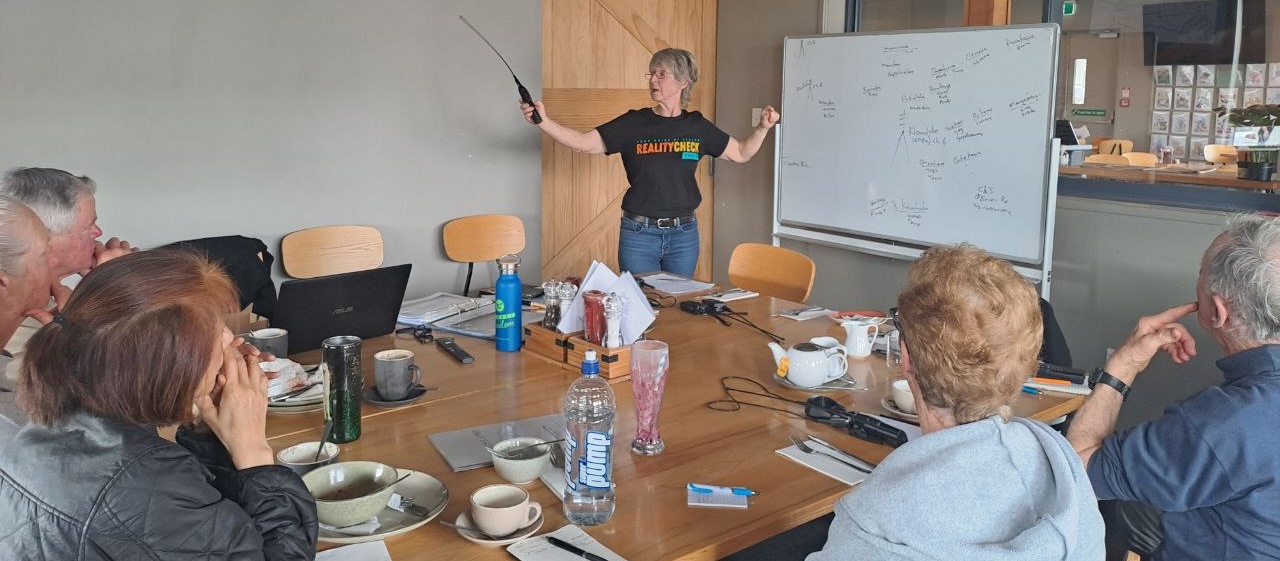
‘Resilience’ has been a catch-cry for many people over the last few years. Rebuild Free Radio Network (RFRN) Radio Area Coordinator for North Waikato, Trish Murray, is part of a scheme to build a national, community-led radio network.
A licensed ham radio operator operator herself, Trish said the network was aware ham wouldn’t work for everyone interested in connecting via radio, so RFRN is utilising a network of PRS handheld radios.
Radio ham licences come at a cost, and with compulsory training and testing, they’re not suitable for many time-poor people.
Trish said she was familiar with the feeling of being ready to ‘get talking’ after completing her ham radio licence.
As a coordinator with the RFRN, she knew there was a mix of people out in the community, at varying stages of their radio journey.
“Many people bought radios, and some had started using them,” said Trish. “Some radios were still in the box. And many hadn’t decided yet if they even want a radio.”
As a result, Trish decided to offer some training in the form of very hands-on, interactive workshops.
“We talked about why the need for a radio, how they work, different types of radio, channels, repeaters, antennas, distances covered, and even what to say. Some of the concerns related to me were that they wouldn’t know what to say, or who would they talk to.”
So Trish used a whiteboard to create a rough diagram of the areas the attendees lived in, and showing local repeaters.
But the goal was to get people talking, so Trish marched the attendees outside.
“We had radio users there, so we went outside, split into groups, and literally got people calling each other. We used repeaters and simplex, doing channel changes, and practising putting calls out.”
Trish said the workshop attendees responded well to this strategy. They left the workshop feeling more confident, and some even decided to buy radios as a result.
The interactive workshop format also meant that Trish could make personalised recommendations to suit each situation.
Some radio users needed to know they could reach their mum in a rest home where no roof antenna was possible, or contact a family member an hour’s distance away.
“This meant travelling with a helper after the workshop to these locations and doing some radio calls for range tests. Additionally we have been doing test nets and seeing who we could reach and on what type of antenna.”
Trish said she found extended range whip antennas to perform very well, although roof antennas are the preferred option for practical reasons.
“But we’re trying out a range of solutions to see what’s best. Magnetic roof mount car antennas are also working really well. We use a repeater as a “gathering point” and then do a ‘by area’ split to go to simplex. The area we are working within is from Papatoetoe to Te Kauwhata, and then coast to coast, so a number of simplex areas.”
Trish said the community network contains people who are mostly new to radio.
“It’s really inspiring seeing their confidence grow, and to hear their first tentative calls.”
RFRN also involves experienced radio users, with others now keen to go on and work towards their ham licences, which Trish is encouraging them to do.
“Personally, I am loving seeing friends and family connecting on radio, and finding it really heartening having others jump in to offer help building the Rebuild Free Radio Network.”
Glossary of Radio terms:

Frequency = The cycles per second of the radio transmission.
Hertz = the unit of measurement for frequency.
Mega = million (1 megahertz is 1 million hertz)
Mhz = Megahertz. This is how many million hertz (MHz should not be confused with mhz (millihertz) which would be millionths of a hertz!)
CB = Citizen’s Band. (about 26/27mhz) This is the frequency of the long range radio.
SSB = Single Side Band. This is a more efficient way to transmit, thus increasing the distance you can communicate over.
PRS = Personal Radio Service. Sometimes incorrectly named as “CB” (This is the new version of public radio which superseded CB radio, but CB is still able to be used.)
HF = High Frequency (the long range CB radios are in the HF band).
VHF = Very High Frequency (marine radios are in the VHF band).
UHF = Ultra High Frequency (PRS radios are in the UHF band).
Band = A range of frequencies labeled as a group to identify what area of the radio frequency spectrum is being used/discussed. This can be used to identify either a wide range of frequencies, such as “The HF band”, or a narrower range of frequencies within a wider band, such as “The CB band” which is within the HF band.
Squelch = the setting of the level at which your radio will allow an incoming signal to “open the channel”. For example, a low squelch setting of 1 will allow distant weak signals to be heard out of the speaker on your radio, whereas a high setting of 9 will only allow nearby strong signals to be heard out of the speaker on your radio.
VOX = Voice operated transmit function. When enabled, your radio will transmit on the selected channel whenever you speak into it.
Channel = the selected frequency your radio is set to, labeled by numbers. (The PRS band has 80 channels)
SWR = An acronym for Standing Wave Ratio. This is a measure of how well the antenna matches the transmission output frequency. A value of “1” means “unity” or in layman’s terms; a perfect fit. A value any higher than “1.5” is not acceptable to transmit.
CASE STUDY: Hawke’s Bay Interference: How Did We Resolve This?
Following our National Coordinator Linc’s first presentation to keen radio enthusiasts in Hawke’s Bay, a group of ten people made the investment in PRS radios.
Initial reports were good, using whip antennas for short range connection, and the group began to erect their roof antennas.
Linc reported:
“I helped with two roof antennas, and did some testing at both ends. The expectation was that these two parties, about 15kms apart, would be able to talk to each other but we couldn’t establish communications, which was disappointing. We could hear some static on the radio, but it wasn’t performing very well.”
Having had a previous experience in the Marlborough area—where a pocket of interference had been resolved with a Techoman-supplied filter—Linc determined that the Hawke’s Bay issue may also potentially be filtering.
Acquiring a few handsets with improved filtering, Linc arranged for testing in several locations.
Because the use of these handsets resolves interference issues, they consequently provide better range.
Further testing helped the Hawke’s Bay pair that Linc was supporting to communicate across 15kms easily with the improved equipment, and double that distance to another point-of-contact.
As a result, the radio group has been recommended to upgrade their PRS to the handset with improved filtering.
The equipment will help them connect, provide better range, and is slightly more water resistant. However, it is a little more expensive.
Supplier, Techoman, can provide a small trade-in rebate of $30 on a returned radio upgrade, but a better option for the Hawke’s Bay group was to sell their existing PRS radios—secondhand but barely used—to interested people in other regions.
While the cause of the interference issue in Hawke’s Bay remains a mystery, thanks to connection and communication between Linc and the group, a resolution to the problem has at least been found, which may prove useful in other areas facing similar issues as time progresses.
MAP
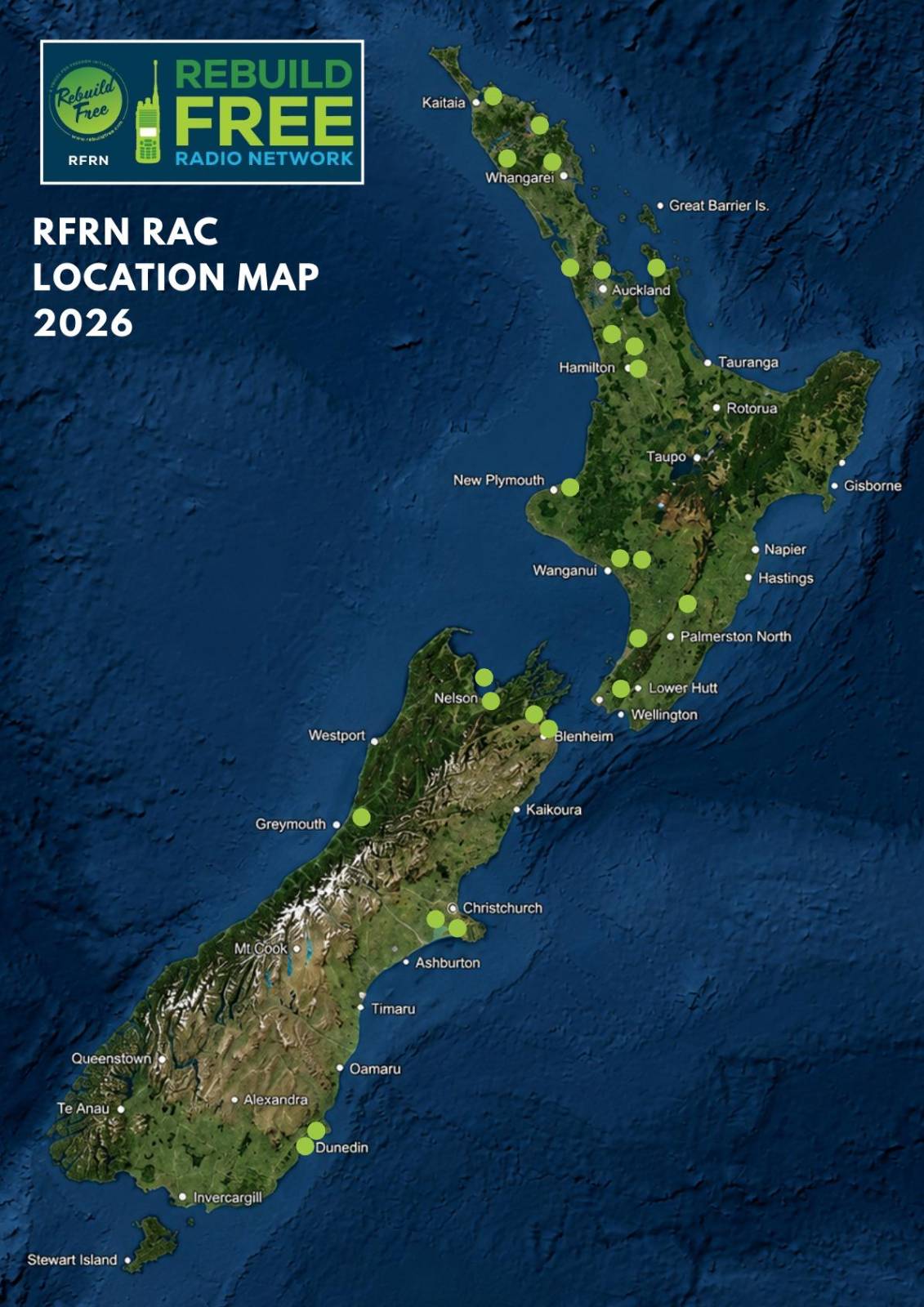
This map shows our Rebuild Free Radio Network (RFRN) Radio Area Coordinator (RAC) locations to date; areas where people are connecting via PRS or longer wave radios.
RFRN Network Map, July 2026
Radio Systems
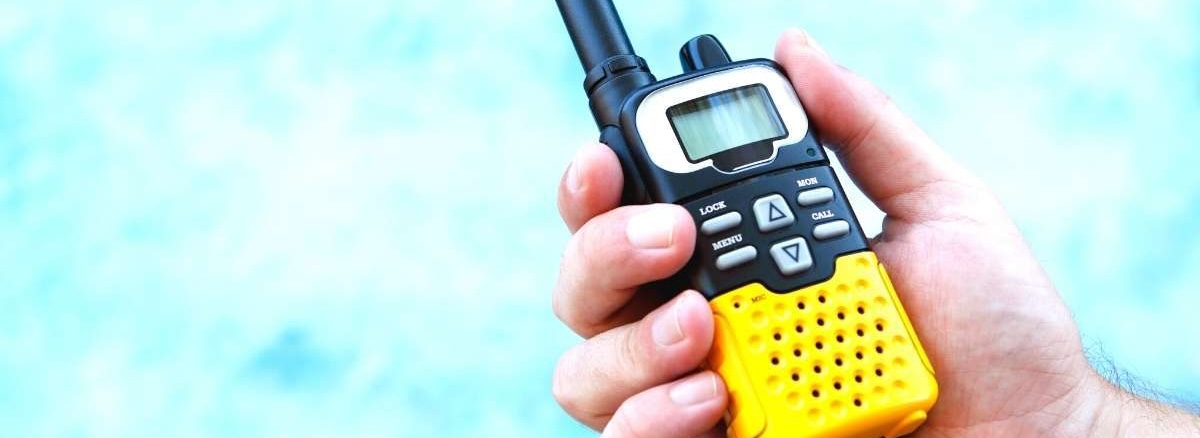
Imagine the unthinkable: There has been a natural disaster, the cellphone system is overloaded with calls, much of the hardware connecting you to the internet is down, and you’re hearing constant pleas to only text people, but text messages are taking hours. How do you connect to your support groups?
Now, stop imagining. This is what happened in Christchurch after the earthquake. Not only was the local cellular system overloaded, but much of the NZ infrastructure suffered serious congestion, Luckily this was only a local event and the rest of the new Zealand system managed to carry the traffic, and supply additional resources, the system did not fail, but it highlighted a problem with our internet-based systems. What happens when they go down.
While many candidates are looking to enter this market as potential solutions, there is an old-school method that may not cost you very much and you won’t need any contracts or monthly fees. Yep, we are talking basic two-way radios.
For most people, this conjures the image of walkie-talkies, and some 70s tv shows with “Breaker 19” being called by truckers, and CB radios are still used today in trucks, but two-way radio has a lot more going for it than just strange lingo and lids walkie talkies.
Modern radio systems are still used by Ambulance and Fire and Emergency as their primary communication, The systems carry both voice and data and can even provide basic internet connectivity. But for our applications, let us just consider voice options.
We have three options.
- Buy a Commercial License. Commercial licensing is possible and can work, or you can share a frequency with others by leasing space on a system. The lease idea is what you do every month with your cellphone, but with a radio, you might be able to talk direct radio to radio, even if the system goes down. But bit the rentals costs and the equipment cost make this an expensive exercise.
- Use Unlicensed radio bands. CB Radio (27Mhz) and PRS (477Mhz) frequencies have been allocated for use by private citizens using low-cost, low-power radios. These can be handheld or designed to be installed in a vehicle with an external antenna… Once you own the radio, you can use it with no license required, but you have to share the space with other users, but there are up to 80 channels to use. The low power means low range with handhelds giving about a 1 kilometre range and vehicle-mounted units getting up to 7 kilometres if there is nothing between you.
- Use the amateur radio bands. Amateur radio operators are given many frequencies, and power limits up to 1,000 watts. This allows communication not only within New Zealand but around the world. In addition “Hams” have also set up repeaters, and even networks of repeaters that allow them very long-range communications, and HF radios can communicate hundreds or even thousands of kilometres.
For easy entry and short-range communications, PRS radio is usually the cheapest and easiest option. You purchase some off-the-shelf, type-approved, radios and you are all good to go, some cities have local repeaters that allow you to get more range, but remember everyone can hear what you say, and may even join in, so many people use a “handle” (nickname) rather than their real names. You no longer need callsigns but some of us use callsigns (letters and numbers) to help us identify as a group. A list of NZ repeaters is kept here: https://blowonthepie.co.nz/prs-uhf-repeaters-nz/
Amateur Radio Operators
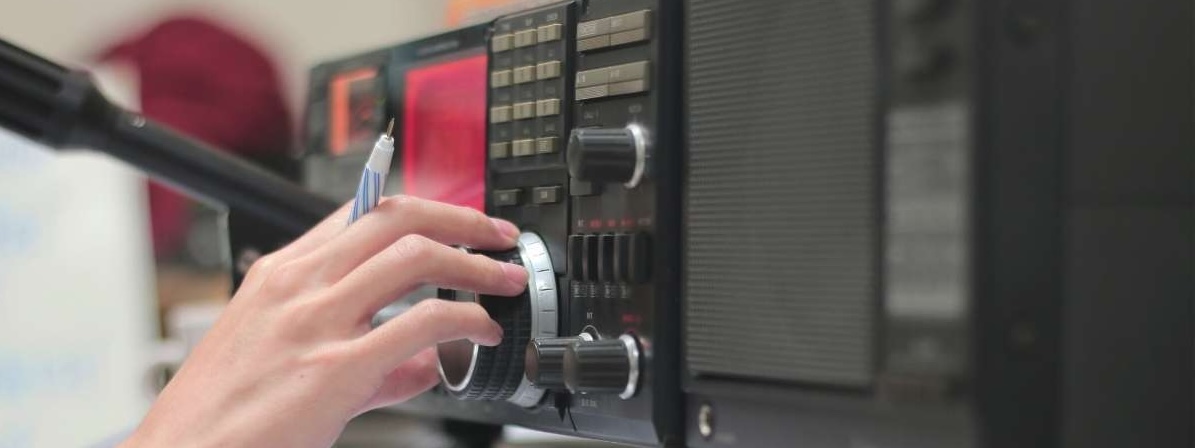
Ham Radio (amateur radio operator) requires that every user sits and passes a competency examination, and gain a General User Radio License (GURL) which can be obtained by any NZ citizen who has passed the exam, and paid the fee to Radio Spectrum Management (RSM), currently 100 dollars for a lifetime license. There is no age limit for anyone who wishes to sit the exam, many clubs arrange local classes, and there are online classes you can use to prepare for the 60-question test.
Amateur radio equipment can be expensive, but there is also a lot of good quality second-hand equipment that can be purchased by anyone holding a GURL that can be used on the amateur radio bands, and many amateurs will be so happy to see new members that they will help. Amateurs use both commercial and also home-built equipment to run their stations, and many hams have gone on into careers in electrical or electronics using the skills they gained as amateurs. In a later article, I will explain how to get your license.
So unlike a cellphone Radios do not need a network to operate. Radios can talk directly and once you know-how, an amateur radio operator can set up a station anywhere. Many use batteries, solar panels, and homebuilt antennas to perform field operations from any place they need to. So it can be both a hobby and also a way to gain technical skills.
So, what’s your backup plan to communicate?