
Your Rights, Your Options, and What We’re Trying to Find Out
Roadside saliva drug testing is now being rolled out across New Zealand.
Since it began, we’ve heard from hundreds of concerned Kiwis. While many support keeping genuinely impaired drivers off our roads, they also have serious questions about how the testing programme operates and whether enough information has been made publicly available.
The questions we receive most often are surprisingly simple:
What exactly is in the roadside saliva testing device?
What happens to my saliva sample after testing?
What are my rights if I’m stopped by the police?
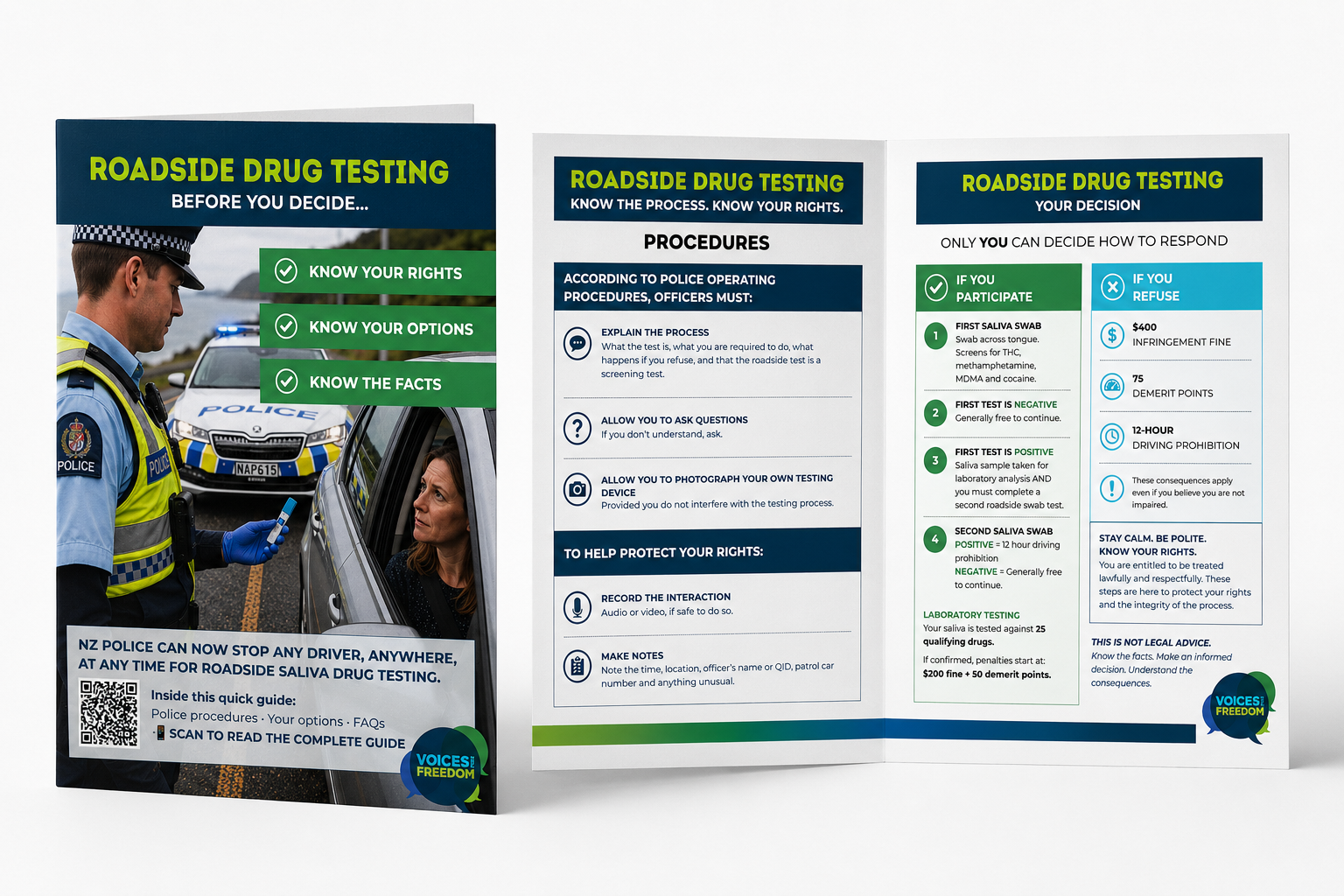
This guide explains what the law currently requires, what happens during roadside drug testing, the consequences of refusing a test, and what Voices for Freedom is doing to obtain answers to the questions many New Zealanders are asking.
Why are people concerned?
Most New Zealanders support efforts to reduce impaired driving.
However, many people have contacted us with concerns that go beyond the purpose of the testing itself.
The roadside screening process requires drivers to swab a saliva collection device inside their mouths. Naturally, people want to know exactly what that device contains, what happens to the saliva sample after testing, and what safeguards exist around any biological material collected during the process.
The roadside drug test is also different from an alcohol breath test, which does not physically touch you or collect body samples.
Among the questions we’ve been asked are:
- What chemicals or reagents are contained within the saliva collection device?
- Is there a publicly available Safety Data Sheet (SDS) for the device?
- Has the composition of the device been independently assessed?
- What happens to saliva samples after testing?
- Is any biological material retained or destroyed?
- What safeguards exist to prevent secondary use of biological material?
One issue causing particular concern is that information about the composition of the roadside saliva testing device has reportedly been withheld on the grounds of commercial sensitivity.
That has left many people asking a simple question:
If the Government can require someone to place a saliva collection device inside their mouth, shouldn’t they also be entitled to know what that device contains?
Regardless of where people stand on roadside drug testing itself, we believe transparency is important. If New Zealanders are required by law to use a medical device, it is reasonable for them to ask questions about it and to expect clear answers.
Who can be tested?
Who can be tested?
The roadside saliva testing regime applies to drivers of motor vehicles.
Police can stop any driver, anywhere, at any time for roadside drug screening. They do not need reasonable grounds or suspicion that a driver has taken drugs before requiring a roadside screening test.
This is similar to existing roadside alcohol breath testing powers.
What happens if I’m stopped?
There are a number of steps in the process:
Step 1: The roadside saliva screening test
Police will ask you to swipe a collection pad across the front of your tongue.
The roadside device screens for four drug groups:
- Cannabis (THC)
- Methamphetamine
- MDMA
- Cocaine
If the first test is negative
The roadside testing process generally ends and you are free to continue your journey.
If the first test is positive
Police will require you to:
- provide a saliva sample for laboratory analysis, and
- complete a second roadside saliva mouthswab screening test.
Step 2: The second roadside test
If the second roadside test is positive, Police will issue an immediate 12-hour driving prohibition.
If the second roadside test is negative, you are generally free to continue driving once the roadside process is complete.
Step 3: Laboratory testing
If your first roadside test was positive, your saliva sample is sent to a laboratory for testing against 25 qualifying drugs.
Importantly, a positive roadside test does not automatically result in a fine.
Only if the laboratory later confirms one or more qualifying drugs above the legal threshold will an infringement notice be issued.
Current infringement penalties are:
- One qualifying drug: $200 fine and 50 demerit points.
- Two or more qualifying drugs: $400 fine and 75 demerit points.
Can I refuse the roadside saliva test?
Yes.
However, there are legal consequences.
If you refuse or fail to comply with the roadside drug testing procedure, you may receive:
- a $400 infringement fine
- 75 demerit points
- a 12-hour driving prohibition.
Every person will need to make their own decision.
Voices for Freedom cannot advise people whether they should refuse a lawful Police requirement. Our role is to ensure New Zealanders understand both their legal rights and the consequences of the choices available to them.
What are my rights during roadside testing?
While Police have broad powers under the legislation, drivers also have rights.
You can ask questions
Police procedures indicate officers should explain:
- what the test is
- what you are required to do
- what happens if you refuse
- that the roadside test is a screening process rather than a determination of impairment.
If you don’t understand the process, politely ask the officer to explain it.
You may record the interaction
If it is safe and practical to do so, consider recording the interaction.
If you are alone, an audio recording may assist.
If you have a passenger, they may be able to video the interaction provided they do not interfere with Police carrying out their duties.
You may photograph your own testing device
Police training material indicates drivers may photograph their own testing device provided doing so does not obstruct Police or interfere with the testing process.
Stay calm and courteous
Whatever your personal views about roadside drug testing, remaining calm, polite and respectful will generally make the interaction easier and help ensure the process is properly documented.
Can you ask for a different type of test?
You can ask.
You can ask Police whether they would allow you to undertake a Compulsory Impairment Test (CIT) instead of a roadside saliva test.
A CIT is a behavioural assessment carried out by a specially trained Police officer. It involves eye assessments, a walk-and-turn assessment and a one-leg stand assessment.
However, Police do not have to agree and drivers do not have a legal right to choose a different testing method.
Can I ask for a blood test instead?
No.
Drivers cannot choose to have a blood test instead of a roadside saliva test. A blood test may only be required by Police in the limited circumstances set out in the Land Transport Act 1998, for example where a driver is unable to provide a sufficient saliva sample.
Can I ask for a urine or other drug test instead?
No.
The roadside drug screening regime uses oral fluid (saliva) testing. The legislation does not provide drivers with the option of choosing a urine test or another type of drug test instead.
Can I have my own independent laboratory sample?
Yes.
If Police collect a saliva sample for laboratory analysis, you may elect to provide a second saliva sample for independent laboratory testing at your own cost. Police provide the collection equipment as part of the roadside testing process; you arrange and pay for the independent analysis.
Can you ask what the swab contains?
Yes.
You can ask Police questions about the testing device. However, Police have advised they do not hold the complete list of ingredients for the DrugWipe 3 S because that information is proprietary to the manufacturer.
What about prescription medicines?
Having a prescription does not exempt a driver from roadside saliva testing.
Police may still require the testing process to be completed.
However, if an infringement notice is later issued in relation to a prescribed medication, a statutory medical defence may be available if the medication was lawfully prescribed and taken in accordance with medical instructions.
This may also apply to some medicinal cannabis patients. A valid prescription does not prevent a positive roadside screening result or a 12-hour driving prohibition following two positive roadside tests, although a medical defence may be available later if an infringement notice is issued.
What happens with the testing devices and saliva collected?
Police say:
- Used roadside screening devices (whether the result is positive or negative) are disposed of as secure biohazard waste. They are not stored by Police and are not returned to the driver.
- Police also state that they do not create DNA profiles or collect biometric information from saliva samples.
- Drivers may elect to provide a second saliva sample for independent laboratory testing at their own cost.
However, Police have not explained what happens to saliva samples collected for laboratory testing after they reach the laboratory, including how long they are retained, who has access to them, or when and how they are ultimately destroyed. Those remain important questions.
https://www.police.govt.nz/advice-services/drugs-and-alcohol/roadside-drug-driving-testing?
What if I think Police didn’t follow the procedure?
Make notes as soon as possible while events are fresh.
If possible, keep any recordings, photographs or witness details. You may also wish to request your information from Police under the Privacy Act and consider making a complaint if you believe the procedure was not properly followed.
Can you get a copy of what Police hold about your stop?
Yes.
You can request your personal information from Police under the Privacy Act 2020, including records relating to the stop and testing process.
What Voices for Freedom is doing
As concerns about roadside saliva testing have grown, we asked New Zealand Police to meet with us to discuss the questions many New Zealanders have raised.
Police declined our request.
Police have answered some questions through the Official Information Act, including confirming that:
DrugWipe 3 S roadside screening device
- has been verified as biologically safe;
- complies with applicable biological safety standards; and
- the manufacturer has not provided Police with the complete list of ingredients because that information is proprietary.
Quantisal saliva collection device
Police have confirmed that the collection device consists of:
- an untreated cellulose (filtration paper) collection pad;
- a polypropylene stem;
- a food-grade blue dye (<0.01 g); and
- a transport buffer containing:
- sodium phosphate buffer (<2%); and
- ProClin 300 preservative (<1%).
Police also provided:
- a Quantisal composition sheet;
- a manufacturer biocompatibility statement; and
- an Ahlstrom paper specification.
While this information is helpful, many important questions remain unanswered.
We have therefore lodged further Official Information Act requests seeking information about:
- the complete chemical composition of the DrugWipe 3 S roadside screening device;
- any Safety Data Sheets (SDS) or equivalent health and safety documentation provided to Police;
- what happens to saliva samples after testing;
- how biological material is handled, transported, stored and ultimately disposed of;
- Police procedures governing roadside testing;
- officer training and competency requirements;
the guidance provided to officers when members of the public ask questions about the testing devices and testing process; - whether the police are operating under any quotas;
- the procurement information relied upon by Police when determining the devices were appropriate for public use.
The question we hear more than any other is simple:
“What exactly am I being asked to put in my mouth?”
We believe that is a reasonable question.
Police have advised that they do not hold the complete list of ingredients used in the DrugWipe 3 S because that information is proprietary to the manufacturer. However, given that New Zealanders are required by law to undergo roadside saliva testing or face legal consequences for refusing, we believe there is a strong public interest in ensuring transparent information is available about the devices being used.
We also believe New Zealanders deserve clear answers about the composition of the testing devices, the handling of biological samples, the safeguards that exist throughout the testing process, and the information provided to Police officers who administer the tests.
Once we receive Police’s responses to our further Official Information Act requests, we will publish that information so New Zealanders can make informed decisions based on the facts.
At a Glance
| Question | Answer |
|---|---|
| Can Police stop any driver? | Yes. |
| Do Police need suspicion? | No. |
| Who can be tested? | Drivers of motor vehicles. |
| What does the roadside test screen for? | THC, methamphetamine, MDMA and cocaine. |
| Can I refuse the test? | Yes, but there are legal consequences. |
| What happens if I refuse? | $400 fine, 75 demerit points and a 12-hour driving prohibition. |
| Can I ask questions about the process? | Yes. |
| Can I ask for a different test? | You can ask, but Police do not have to agree. |
| Can I have my own laboratory sample? | Yes, at your own cost. Police will provide the sample collection device. |
| Can I record the interaction? | Generally, yes, provided you do not interfere with Police procedures. |
| Can I photograph my own testing device? | Police procedures indicate that you may photograph your own device provided you do not interfere with the process. |
| Does a prescription exempt me from testing? | No. |
| Can I get information about my stop? | Yes, under the Privacy Act. |
Have you been through roadside drug testing?
We’re interested in hearing from people who have experienced the roadside drug testing process firsthand.
In particular, we’d like to hear if:
- you asked questions about the testing device or what it contains
- you requested information about the chemicals or reagents used in the device
- you were refused information about the testing process
- you felt the procedure was not properly explained
- you were prevented from photographing your own testing device
- the testing process took significantly longer than expected
- you encountered issues with how the test was carried out
- you have photographs, documentation or other information that may assist our enquiries.
Every experience helps us build a clearer picture of how the programme is operating in practice.
If you’ve been through roadside drug testing and are willing to share your experience, please contact us at hello@voicesforfreedom.co.nz.
Your information may assist our ongoing work to improve transparency, hold public agencies to account, and ensure New Zealanders are fully informed about their rights.
Thanks for reading and sharing! Remember to sign up to our mailing list to keep up with the latest news.
If you value what we are up to at Voices and would like to support our ongoing work you can donate and support our nationwide public education campaigns (webinars, flyers, billboards...) and other initiatives to speak up and push back for your freedoms.